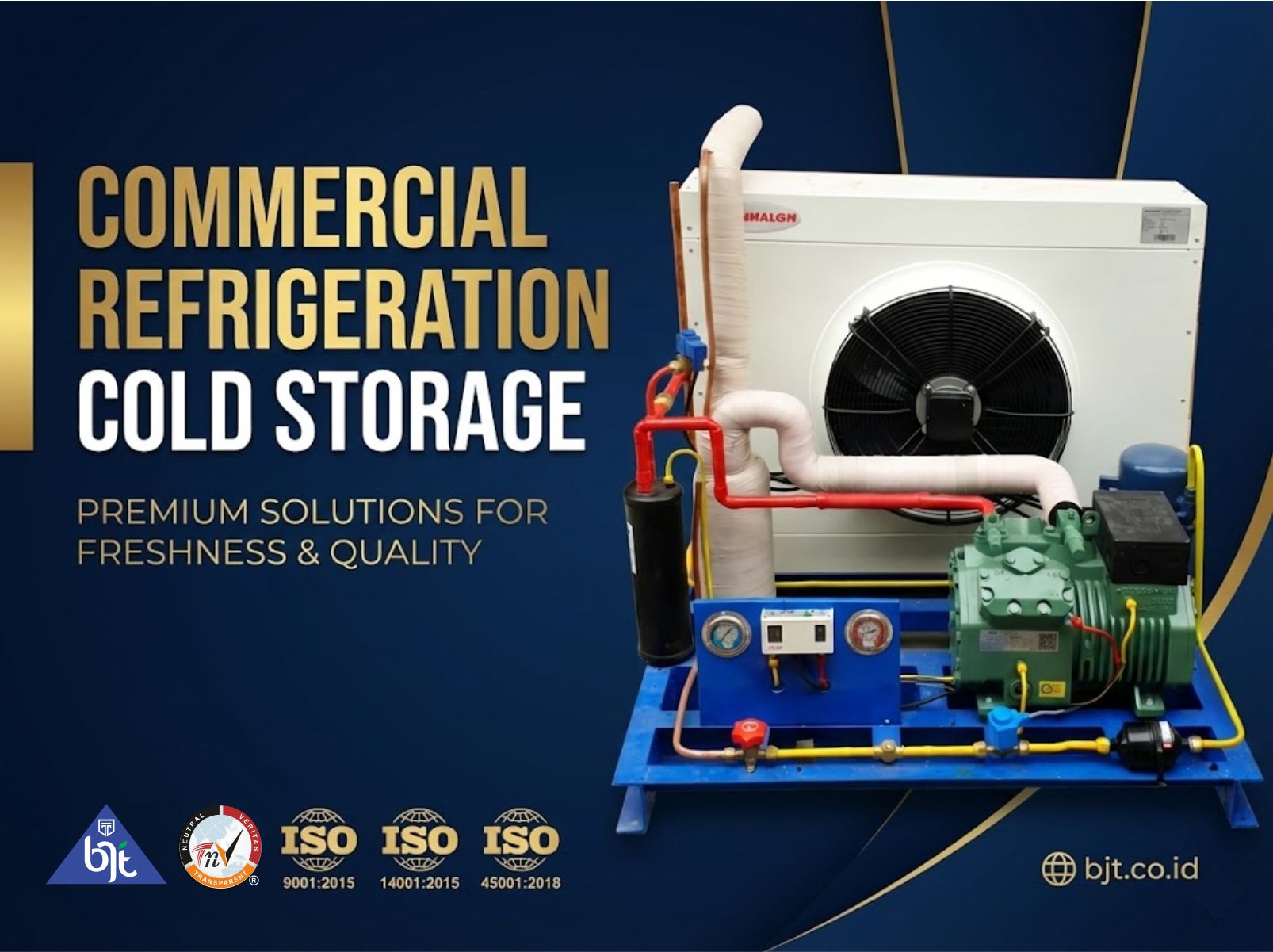

Cold Storage Commercial Refrigeration BJT
Commercial refrigeration plays a vital role in preserving the freshness and safety of perishable products across various industries. In recent years, especially following the pandemic, the demand for commercial refrigeration solutions has seen significant growth in India. With the rise in frozen food consumption, expansion of cold chain logistics, and the increasing number of cloud kitchens, medical facilities, and hospitality businesses, businesses are increasingly investing in high-quality refrigeration systems. Choosing the right commercial refrigerator is a critical decision as it impacts food preservation, operational efficiency, and cost-effectiveness.
Unlike residential refrigerators, commercial refrigeration units are specifically designed for heavy-duty usage, accommodating larger storage capacities and maintaining stable temperatures despite frequent door openings. PT. BJT Indonesia, a leading expert in commercial refrigeration and cold storage solutions, provides advanced technology to ensure high-performance cooling systems that meet diverse industry needs. Businesses must carefully assess various factors when selecting a commercial refrigerator, such as storage requirements, available space, energy efficiency, and essential features.
A commercial refrigerator is a high-performance cooling unit designed to maintain optimal temperatures for perishable goods. These refrigerators are commonly found in restaurants, supermarkets, food processing units, bakeries, pharmaceutical facilities, and even airports. They ensure that food, beverages, and sensitive medical products remain fresh and safe for consumption. The durability, efficiency, and specialized functions of commercial refrigeration units make them indispensable for industries that require stringent temperature control.
The key features of commercial refrigeration units distinguish them from regular home refrigerators. These units are constructed using robust materials such as stainless steel to enhance durability and hygiene. They also offer adjustable shelving to accommodate various storage needs and advanced cooling mechanisms like forced air circulation to ensure even temperature distribution. PT. BJT Indonesia integrates state-of-the-art digital temperature control and IoT-enabled systems, allowing businesses to monitor and manage their refrigeration units remotely. Safety locks, self-defrosting capabilities, and real-time temperature monitoring further enhance their reliability and efficiency.
The role of commercial refrigeration spans multiple industries, from food and beverage to pharmaceuticals. Grocery stores, supermarkets, and restaurants rely on these systems to store fresh produce, dairy products, and meats. Meanwhile, pharmaceutical companies and hospitals use specialized refrigerators to preserve temperature-sensitive medicines and vaccines. Flower shops and plant nurseries also benefit from commercial refrigeration to keep their products fresh for longer periods. PT. BJT Indonesia’s innovative cold storage solutions cater to a wide range of industries, providing tailored refrigeration systems to meet specific operational requirements.
Custom Cold Storage Solutions: Tailored to Your Business Needs
In today’s competitive market, the storage requirements of businesses vary significantly depending on the nature and scale of their operations. Recognizing that no single solution fits all, we provide custom-designed cold storage rooms that cater to the unique storage demands of each business. Whether you operate a small local business or a large-scale enterprise, our range of cold storage options is designed to meet your specific needs, ensuring that your products remain fresh and safe for consumption.
Tailor-Made Cold Storage for Diverse Business Needs
Every business is unique, and so are its storage requirements. For many businesses, especially those handling perishable goods, the need for efficient, reliable, and flexible storage solutions is paramount. We understand that a one-size-fits-all approach simply doesn’t work in today’s fast-paced commercial environment. That’s why we offer a variety of cold storage options with different capacities and temperature control settings, allowing you to choose the solution that best aligns with your operational needs.
Our custom-built cold storage rooms are designed with versatility in mind. They can be constructed to fit a wide range of capacities—from compact units suitable for a boutique grocery store to expansive cold rooms that serve large food processing plants or pharmaceutical facilities. By tailoring the dimensions of your cold storage facility, we ensure that every inch of available space is optimized for storage, reducing wasted area and enhancing operational efficiency.
Precision Temperature Control for Maximum Product Quality
Maintaining the right temperature is critical for preserving the quality of perishable goods. Different products have varying temperature requirements, and a well-calibrated cold storage system must meet these specific needs to prevent spoilage and maintain product integrity. Our cold storage solutions are equipped with advanced temperature control systems that allow for precise adjustments based on the material being stored.
For example, produce such as fruits and vegetables typically requires a controlled environment that keeps them fresh without causing premature deterioration. By setting the temperature within a specific range, we can extend the shelf life of these items and maintain their natural flavor and nutritional value. Similarly, frozen foods, meats, dairy products, and even pharmaceutical items have distinct temperature requirements that our systems are designed to accommodate.
Different Types of Cold Storage Based on Temperature Range
Our range of cold storage facilities includes several types, each differentiated by the temperature range they achieve and the specific products they are designed to store. Here are the primary categories:
-
Chiller Room (10°C to 0°C):
Chiller rooms are ideal for storing items that require a cool, but not freezing, environment. Typically maintained between 10°C and 0°C, these rooms are perfect for vegetables, fruits, and other perishable foods that have a shelf life of no more than 60 days. The controlled conditions in chiller rooms are also well-suited for certain pharmaceutical products that demand a consistent and moderate cool temperature. The advantage of chiller rooms is that they slow down the natural ripening process and delay spoilage, ensuring that products remain in optimal condition until they are needed. -
Freezer Room (-15°C to -20°C):
For products that require a much lower temperature to remain preserved, freezer rooms are the go-to solution. Operating between -15°C and -20°C, freezer rooms are designed for the storage of meat products such as beef and chicken, as well as dairy items like milk and fish, and even fast foods. The sub-zero environment in these rooms is crucial for preventing bacterial growth and ensuring that products remain safe for consumption over extended periods. Freezer rooms not only help maintain the quality of frozen goods but also facilitate the efficient storage of large volumes of products, making them ideal for high-demand operations. -
Air Blast Freezer (-35°C to -40°C):
In some cases, rapid freezing is necessary to preserve the quality of products by quickly lowering their temperature. Air blast freezers are designed for this very purpose. Operating at extremely low temperatures between -35°C and -40°C, these units use high-velocity cold air to rapidly cool products, effectively locking in freshness and nutritional content. This method is especially beneficial for products that are sensitive to prolonged exposure to temperature fluctuations or those that require a quick transition from the production line to storage. The rapid freezing process minimizes the formation of ice crystals, which can damage cellular structures in food products, ensuring that the texture and quality are preserved upon thawing.
Advanced Technology and Materials for Cold Storage Machine Performance
Beyond just temperature control, our cold storage facilities are built with state-of-the-art technology and high-quality materials to ensure maximum efficiency and durability. The construction of these rooms incorporates advanced insulation materials that prevent the exchange of heat, ensuring that the desired temperature is maintained with minimal energy consumption. Sealed doors, robust refrigeration systems, and easy-to-clean surfaces all contribute to an environment that is not only efficient but also hygienic.
The importance of using specialized materials cannot be overstated, especially in industries where hygiene and precision are critical. Whether it’s in a chiller room used for storing fresh produce or a freezer room meant for meat and dairy products, the construction materials are chosen to ensure long-lasting performance and consistent temperature regulation. This careful attention to detail helps prevent temperature fluctuations that could compromise the quality of stored goods.
Meeting Global Standards and Ensuring Food Safety
In the context of today’s global market, ensuring food safety and meeting international standards is more important than ever. Our cold storage solutions are designed to comply with stringent food safety regulations, ensuring that your products are stored under conditions that prevent contamination and spoilage. By maintaining an environment that inhibits the growth of bacteria, fungi, and other pathogens, our facilities help ensure that food products and pharmaceuticals remain safe for consumption.
Moreover, the controlled environments in our cold storage rooms help prevent cross-contamination between different types of products. This is especially critical in multi-product facilities where diverse items, from fresh produce to frozen goods, are stored together. The ability to maintain separate temperature zones within a single facility means that each product is kept in an environment tailored to its specific needs, thereby preserving its quality and safety.
Flexible Solutions for a Dynamic Market
As the global market evolves, so too do the demands of businesses. The ability to quickly adapt to changing storage requirements is a significant advantage for companies operating in dynamic industries. Our custom-built cold storage facilities are designed with flexibility in mind, allowing businesses to scale their storage capacity as their needs grow. Whether you’re expanding your operations or looking to optimize your existing storage, our solutions provide the flexibility necessary to keep pace with market demands.
From small local retailers to large multinational corporations, every business can benefit from a cold storage solution that is tailored to its specific requirements. Our approach ensures that you have the right storage environment for your products, ultimately contributing to improved product quality, reduced waste, and increased customer satisfaction.
Conclusion
In summary, the diverse storage needs of today’s businesses require custom solutions that are both flexible and efficient. By providing cold storage rooms that are tailored to individual requirements, we ensure that every business, regardless of its size, has access to the optimal storage environment for its products. With options ranging from chiller rooms for fresh produce and pharmaceuticals, to freezer rooms for meats and dairy, and air blast freezers for rapid cooling, our cold storage solutions are engineered to meet the highest standards of quality and efficiency.
Investing in the right cold storage facility not only safeguards the quality of your products but also enhances your operational efficiency and helps you meet global safety standards. With advanced technology, superior materials, and a commitment to customization, our cold storage solutions are designed to support your business’s growth and success in an increasingly competitive marketplace. Whether you require a small-scale unit or a large, multi-zone facility, we have the expertise and experience to deliver a solution that meets your unique needs.
In addition to these primary categories, businesses can choose from various specialized refrigeration units based on their specific needs. Reach-in refrigerators are compact and offer easy access to stored items, making them suitable for cafes and restaurants. Walk-in refrigerators and freezers provide large storage spaces, ideal for bulk storage in supermarkets and large commercial kitchens. Under-counter refrigerators are space-saving models perfect for bars and small kitchens, while storage-cum-display refrigerators showcase products attractively for retail settings.
Blast chillers are used in commercial kitchens to rapidly lower food temperatures, preserving food quality and preventing bacterial growth. Pharmaceutical refrigerators are designed to store sensitive medical supplies at precise temperatures. Plug-in enclosed vending machines allow businesses to vend refrigerated and frozen products, making them ideal for convenience stores. Refrigerated prep tables, which combine workspaces with refrigeration, are essential for efficient food preparation in professional kitchens.
Selecting the right commercial refrigerator requires careful consideration of several factors. Space availability is a crucial element, as these units come in various sizes and require sufficient room for ventilation. Businesses must also evaluate storage capacity, ensuring that the chosen unit can accommodate their inventory needs. The type of refrigerator should align with business operations, whether it’s a walk-in unit for bulk storage or an under-counter model for compact spaces.
Features and functions play a significant role in enhancing operational efficiency. Advanced cooling mechanisms such as forced air circulation and digital temperature controls ensure consistent performance. Adjustable shelving allows for customizable storage configurations, while energy-efficient models help reduce electricity consumption and operational costs. The overall build quality, including durable materials like stainless steel, ensures longevity and ease of maintenance.
Cost considerations extend beyond the initial purchase price. Businesses should account for installation expenses, energy consumption, and ongoing maintenance. PT. BJT Indonesia provides cost-effective refrigeration solutions that prioritize efficiency and durability, ensuring long-term value for business owners. Regular maintenance is essential to extend the lifespan of commercial refrigeration units, which typically last between 10 to 15 years when properly maintained.
Several factors influence the longevity of a commercial refrigerator. High-quality brands offer superior build quality, leading to longer-lasting units. Usage patterns, including frequent door openings and overstocking, can impact performance. Proper placement away from heat sources and direct sunlight helps maintain efficiency. Routine maintenance, such as cleaning condenser coils and inspecting door seals, prevents potential malfunctions and improves cooling performance.
Implementing effective maintenance practices is crucial for optimizing refrigeration performance. Cleaning interior and exterior surfaces weekly prevents bacterial buildup, while monitoring temperature settings ensures food safety. Door gaskets should be checked for wear and replaced if necessary to prevent air leaks. Clearing condenser coils at least twice a year removes dust and debris that could affect cooling efficiency. Proper airflow should be maintained by keeping vents unobstructed, and unusual noises should be addressed promptly to prevent mechanical failures.
Scheduled professional servicing is recommended to identify potential issues before they escalate. Refrigerant levels should be regularly checked, as insufficient refrigerant can lead to cooling inefficiencies. Keeping a maintenance log helps track servicing history and ensures timely repairs. PT. BJT Indonesia offers expert maintenance and support services, helping businesses optimize their refrigeration systems for maximum efficiency and longevity.
Advancements in commercial refrigeration technology have transformed the industry, making refrigeration units more intelligent and energy-efficient. Digital temperature control systems allow precise regulation of cooling conditions, while IoT-enabled refrigerators provide real-time alerts for temperature fluctuations and power failures. Cloud-based management systems enable remote monitoring, allowing businesses to analyze performance trends and optimize operations from any location.
Custom-Built Cold Storage Solutions: Meeting Global Challenges and Customer Needs
In today’s global marketplace, businesses of all sizes face the dual challenges of meeting increasing customer demands while managing operational efficiencies. Cold storage or cold rooms have emerged as indispensable solutions in this environment, offering customizable storage facilities that can be precisely tailored to the specific needs of small, medium, and even large-scale enterprises. By designing these spaces to suit the exact capacity and environmental requirements, businesses ensure that perishable goods—especially frozen food—are stored safely and remain in optimal condition for extended periods.
One of the most significant advantages of modern cold storage solutions is their flexibility in design. Small and medium-sized businesses often operate under unique constraints, ranging from limited physical space to varying storage capacity requirements. With custom-built cold storage units, companies have the freedom to choose dimensions that perfectly match their operational needs. Whether it is a compact cold room designed to store small quantities of fresh produce or a slightly larger facility that accommodates a diverse range of perishable items, the storage area can be precisely engineered to optimize space and enhance efficiency. This flexibility not only allows businesses to save on unnecessary costs but also ensures that every square meter of the cold storage is utilized effectively.
Equally important to the design of a cold storage facility is the ability to control and adjust the temperature settings. The performance of a cold room is not solely determined by its size but also by how well it maintains the required temperature for various stored items. In many cases, the temperature of the cold storage system is tailored to the type of material stored. For instance, fresh produce may require a slightly higher temperature than frozen goods to preserve its natural taste and texture. On the other hand, frozen foods need to be stored at much lower temperatures to prevent thawing and subsequent spoilage. The precise calibration of temperature settings is crucial because maintaining the right conditions directly influences the longevity and quality of stored food items. This customization in temperature control ensures that all products, from dairy and meats to vegetables and beverages, remain safe for consumption and retain their nutritional value.
For larger businesses, the design and construction of cold storage facilities take on a different scale. Enterprises with higher storage demands build expansive cold rooms with significantly greater capacities. These larger cold storage units are engineered to accommodate vast amounts of diverse products, ranging from perishable foods and drinks to non-food items that require controlled environments. The dimensions of such facilities are carefully planned to make the best use of available space, ensuring that the cold storage unit can efficiently serve multiple purposes. In these larger settings, temperature zones may be created within the same facility to cater to the unique requirements of different items. For example, one section might be maintained at a sub-zero temperature ideal for frozen foods, while another area could be set at a higher level suitable for items that are sensitive to extreme cold. This segmented approach allows large-scale businesses to diversify their inventory while ensuring that each product type is stored under optimal conditions.
The fundamental purpose of a cold storage facility is to preserve the quality and safety of its contents by maintaining a controlled environment. The mechanism behind this is relatively straightforward yet highly effective: the refrigeration system continuously works to keep the internal temperature stable, regardless of fluctuations in the external environment. By preventing the spread of heat within the storage space, these systems ensure that every corner of the cold room remains at the required temperature. This constant temperature regulation is critical in preventing the growth of harmful bacteria and fungi, which can quickly contaminate food products and render them unsafe for consumption. In essence, a well-designed cold storage unit acts as a protective barrier, ensuring that perishable goods retain their freshness, nutritional value, and overall quality.
Beyond simply maintaining a constant temperature, cold storage facilities are designed with advanced technology that enhances their operational efficiency. Modern systems incorporate state-of-the-art controls that allow for precise adjustments to the temperature and humidity levels. This is particularly important when storing a variety of products that each have unique requirements. For instance, while frozen foods demand extremely low temperatures to avoid thawing, fresh produce needs a slightly warmer environment to prevent the development of cold-induced damage. The ability to adjust settings in real time means that businesses can respond quickly to any changes in storage needs or external conditions. This dynamic control not only improves the safety and quality of the stored items but also helps reduce energy consumption by ensuring that the system operates at its optimum efficiency.
An equally important function of cold storage is its role in preventing contamination. The risk of bacterial and fungal growth is a constant concern in any facility that stores perishable goods. By maintaining a rigorously controlled environment, cold storage units dramatically reduce the risk of contamination. The cold temperature itself is a deterrent to many pathogens, inhibiting their growth and multiplication. Furthermore, the design of these facilities often includes features such as sealed doors, air filtration systems, and easy-to-clean surfaces—all of which contribute to a hygienic storage environment. These features are particularly crucial for businesses in the food and beverage industry, where even a small lapse in hygiene can have significant repercussions on product safety and customer trust.
The construction of a cold storage facility is also a key factor in its performance. Special materials are used during construction to ensure that the temperature inside the room remains consistent and that the cold air does not escape. Insulated walls, ceilings, and floors, often made from high-quality materials, help to maintain the low temperatures required for effective storage. These materials are chosen not only for their insulating properties but also for their durability and ease of maintenance. The ability to sustain low temperatures without excessive energy use is a testament to the careful planning and engineering that goes into building these facilities. Whether the cold storage is intended for a small local business or a large industrial operation, the construction materials and design principles remain critical to its long-term success.
In addition to providing storage solutions, cold rooms play a strategic role in helping businesses meet global challenges. As supply chains become increasingly complex and customer expectations continue to rise, the need for reliable, efficient, and customizable storage solutions becomes ever more important. Cold storage facilities are now seen as an essential component of modern logistics, helping companies manage inventory, reduce waste, and ensure that products reach their destinations in optimal condition. This is particularly relevant in industries such as food processing, pharmaceuticals, and even high-tech manufacturing, where maintaining specific environmental conditions is vital for product integrity. As companies continue to expand their global operations, having access to a dependable cold storage system is no longer a luxury but a necessity.
Furthermore, cold storage solutions have a significant impact on reducing food waste. By extending the shelf life of perishable items, these facilities play a crucial role in ensuring that food remains fresh until it reaches the consumer. This not only benefits businesses by reducing losses but also has broader implications for environmental sustainability. In a world where food security and resource conservation are of paramount importance, efficient cold storage systems contribute to a more sustainable and resilient food supply chain.
In conclusion, the ability to design and build cold storage facilities that are tailored to specific operational needs is a major advantage in today’s competitive market. Whether catering to small, medium, or large-scale businesses, these custom-built solutions offer unparalleled flexibility in terms of capacity, temperature control, and overall efficiency. By maintaining a stable and controlled environment, cold storage units ensure that perishable goods are preserved safely, reducing the risk of contamination and extending the shelf life of the products. With advances in technology and construction materials, modern cold storage facilities not only meet the immediate needs of businesses but also pave the way for a more sustainable and efficient future in global supply chain management.
As industries continue to evolve, the demand for innovative, reliable, and energy-efficient cold storage solutions will only grow. Meeting these challenges head-on requires a commitment to excellence in design, engineering, and operational management. With its ability to be customized to meet the precise needs of any business—regardless of scale—cold storage remains a critical asset in the quest to provide safe, high-quality products to consumers around the world.
In conclusion, commercial refrigeration is a critical investment for businesses that rely on the safe storage of perishable goods. With technological advancements, modern refrigeration systems have become more efficient, user-friendly, and environmentally sustainable. PT. BJT Indonesia stands as an industry leader, offering cutting-edge cold storage solutions tailored to diverse business needs. By carefully considering factors such as space, capacity, energy efficiency, and maintenance, businesses can make informed decisions that enhance operational efficiency and product quality.